
In the AI era, organizations operate in a constantly shifting environment shaped by rapid technological advances, evolving client expectations, and macroeconomic fluctuations. The underlying logic of organizational transformation has undergone a fundamental shift. In the past, companies relied on long-term transformation plans to steadily achieve goals. Today, strategic visions can quickly become outdated, requiring swift adjustments based on the latest insights. This accelerated pace of planning and iteration demands a rethinking of traditional approaches to change management.
Traditional change management has long been applied across diverse transformation scenarios. When organizations identify a clear goal, teams can leverage structured change management processes to transition smoothly from the current state to the desired future state—standardizing workflows, optimizing systems, stabilizing teams, and ensuring successful execution. This approach works well when goals are clear and the external environment remains relatively stable.
However, in the AI era, rising uncertainty makes static transformation goals less viable. Organizations can no longer afford to wait for clearly defined needs before acting. Leaders must proactively identify opportunities, anticipate shifts, initiate transformation efforts, and continuously adjust strategies to ensure long-term resilience and growth. Change management must therefore expand its boundaries—moving beyond execution of predefined tasks to embrace proactive exploration and continuous iteration.
The eTACSEN 7 Change Leadership Practices
Based on these trends, we have developed the "eTACSEN 7 Change Leadership Practices" framework, drawing on extensive real-world cases from Asian organizations. This model does not discard classic change management theories but rather optimizes and upgrades them to meet modern needs, providing a comprehensive and practical system for contemporary change management.
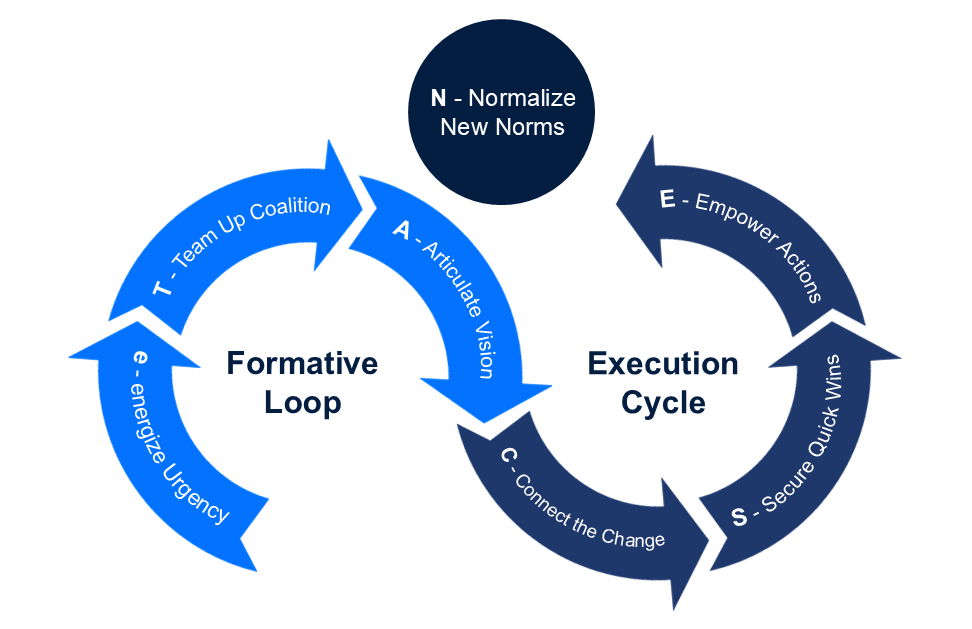
The eTACSEN 7 Change Leadership Practices framework organizes the change process into seven recyclable practices, balancing structured execution with flexible adaptation. It enables leaders to continuously drive transformation in dynamic environments, preventing plans from becoming obsolete. Two core modules anchor the framework: the Formative Loop and the Execution Cycle, creating a continuous closed loop of assessment, action, optimization, and growth.
- Formative Loop – Building a Solid Foundation
Helps leaders iterate quickly and establish a strong foundation for change. In fast-paced environments, objectives can easily become diluted. The Formative Loop guides leaders to validate assumptions continuously, ensuring clarity on problems and desired outcomes before committing significant resources.
- Execution Cycle – Driving Sustainable Action
Provides a sustainable implementation path, allowing organizations to optimize strategies while maintaining transformation momentum. It translates strategic visions into measurable actions, embedding change into daily operations.
Conclusion
In the AI era, the pace of change will only accelerate. Organizations that rely solely on traditional change management models, waiting for clear transformation goals before acting, risk falling behind the market. Leaders must adopt an enhanced approach to change management, proactively discovering opportunities and initiating change.
The eTACSEN 7 Change Leadership Practices framework offers a clear and actionable path for modern change management. By integrating the Formative Loop with the Execution Cycle, it balances forward-looking exploration with orderly execution, enabling leaders to confidently navigate uncertainty.
To further strengthen your organization’s adaptability and change management capabilities, we invite you to explore our Change Enablement Program—designed to help leaders drive successful transitions and achieve sustainable growth in an era of constant change.
